




How to Import EML to Outlook - Complete Guide
 Jack Sam
- Oct 10, 2025
- 741
- 0

Ecommerce brands negotiate their first carrier contract when someone on the finance team notices that shipping costs are too high and asks whether a better deal is available. That is usually too late. By the time shipping costs are painful enough to prompt a conversation with a carrier rep, the business has already absorbed months or years of rates that did not reflect its actual volume.
Carrier pricing is not a fixed schedule. It is a negotiation, and the terms available to a business shipping 50K parcels a month are fundamentally different from the terms available to one shipping 5K. The advantages are real, specific, and most are not automatically offered. You have to understand what to ask for.
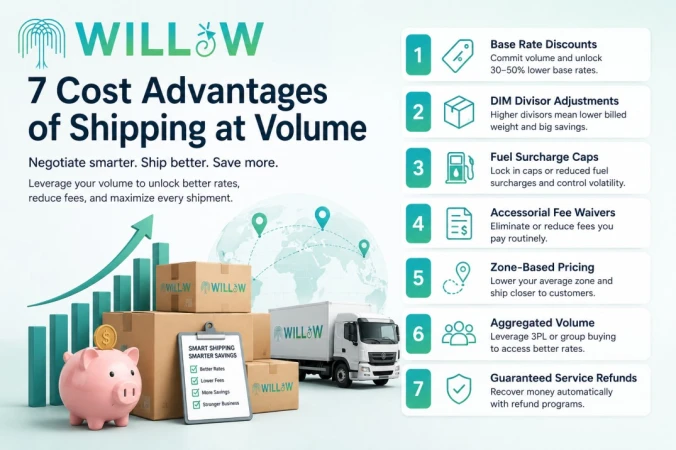
This article covers seven cost advantages of shipping at volume, including how they work, which carriers offer them, and the thresholds that tend to unlock them. None of this requires an enterprise logistics team. It requires knowing what levers exist and building a case for why your volume justifies using them.
Every major carrier, UPS, FedEx, USPS, and regional carriers, has a published rate and a negotiated rate schedule. The published rates are what you pay if you have no contract or a minimal one. The negotiated rates are what you pay when you commit volume, and the carrier has a business reason to keep you.
The gap between published and negotiated rates for parcels is not marginal. For ground services, negotiated rates at meaningful volume can run 30 to 50 % below the published rate card. For express services, the discount can be even higher as a percentage because the published rates for express are already inflated to capture urgency premium from non-contract shippers.
The threshold that triggers meaningful negotiation leverage varies by carrier and by current market conditions, but a useful mental model is that 500 to 1,000 packages per day puts you in a range where a dedicated carrier account representative will engage seriously on rates. Below that, you are likely talking to a standard business development contact whose mandate is to add accounts at catalog pricing.
What makes this particularly relevant now is that carriers are in a more competitive environment than they were three years ago. Regional carriers like LSO, OnTrac, Spee-Dee, and Laser Ship have expanded their geographic coverage significantly, and their entry into markets previously dominated by UPS and FedEx is giving mid-market shippers genuine leverage they did not have before. When you can credibly tell UPS that a regional carrier will take 30 % of your volume at better rates, the conversation about your UPS contract changes.
Dimensional weight is calculated by dividing a package's cubic volume by a divisor. The higher the divisor, the lower the calculated DIM weight, which means lower charges on light-but-bulky shipments. The standard DIM divisor for UPS and FedEx domestic ground is 139. That is the number a non-contract shipper pays. Contract shippers can negotiate a higher divisor.
At a 166 DIM divisor instead of 139, a 12x10x8-inch box that weighs two pounds has a calculated DIM weight of approximately 6 pounds instead of 7 pounds. That single-pound difference across 10,000 such shipments per month is 10,000 billable pounds in savings. The math compounds significantly if your catalog includes light, voluminous products like apparel, sporting goods, or home goods.
This is one of the least discussed line items in carrier contract negotiations and one of the most valuable for the right catalog. The key is knowing your average package dimensions and doing the DIM weight math before you enter negotiation. Walking in with a data model that shows a carrier exactly how much additional revenue they are generating from your current DIM divisor, and presenting an alternative that still keeps them competitive, is a more productive negotiation frame than simply asking for better rates.
USPS Cubic Pricing is the postal equivalent of this optimization. Rather than calculating postage based on weight or DIM weight, Cubic Pricing charges based on the package's cubic volume within defined tiers, regardless of weight. For packages under 20 pounds that fit within standard cubic tiers, Cubic Pricing can produce savings of 20 to 30 % over standard USPS Commercial Plus rates, depending on the product dimensions.
Fuel surcharges are one of the largest sources of unpredictability in carrier billing. UPS and FedEx adjust fuel surcharges weekly based on the U.S. Department of Energy average fuel price index. During periods of fuel price volatility, the surcharge can swing by two to three percentage points in a single quarter, creating shipping cost variance that is nearly impossible to budget against accurately.
High-volume shippers can negotiate fuel surcharge caps, maximum percentage limits that apply regardless of the weekly index movement, and, in some cases, fixed fuel surcharge rates for the contract term. A fuel surcharge cap that holds your rate at, say, 12 % when the index-based surcharge moves to 15 % directly reduces your per-shipment cost during those periods.
The carriers do not volunteer this. It is a negotiated term that requires you to understand that the option exists and to ask for it explicitly. The leverage you bring to this conversation is commitment: you are offering the carrier volume certainty in exchange for cost certainty. The more convincing your volume commitment is, the more credibly you can make the case for fuel surcharge protection.
Regional carriers are often more flexible on this than UPS and FedEx because their cost structures are different and they are actively competing for volume growth. If you are diversifying your carrier mix toward regional carriers, the fuel surcharge structure should be a specific point of discussion in negotiations alongside base rates.
Accessorial fees are charges that appear on carrier invoices in addition to the base transportation rate. Residential delivery surcharges. Delivery area surcharges for rural or extended-area destinations. Address correction fees. Saturday delivery charges. Signature required fees. Each of these is technically optional in a contract context, even though non-contract shippers pay them automatically.
For ecommerce operations with predictable accessorial patterns, specific waivers can generate substantial savings. If 60 % of your shipments go to residential addresses, a residential delivery surcharge waiver or cap is worth modeling carefully. UPS and FedEx currently charge $6.55 and $6.65, respectively, for residential ground delivery. At 10K residential shipments a month, the difference between paying the full surcharge and having it capped at $3.00 is over $35K per month.
Delivery area surcharges for rural destinations are less negotiable because they reflect genuine cost differences for the carrier. But for operations with data on actual rural delivery percentage, understanding which specific ZIP codes in your customer base trigger extended delivery area charges, and routing those selectively through USPS (which does not have equivalent surcharges in most cases), can reduce the effective cost without requiring a formal waiver.
Address correction fees are the most directly actionable. Carriers charge $20 or more per corrected address when a label is printed with insufficient or incorrect address data and the carrier has to correct it in their system. Address validation software that catches errors before label generation eliminates this charge almost entirely at a cost that is a fraction of the per-incident fee.
Carrier pricing for ground parcel delivery is zone-based. Zone 1 and Zone 2 shipments cost less than those from Zones 5 through 8 because they travel shorter distances. The average zone of your shipment mix is one of the most direct determinants of your average cost per parcel, and it is partially controllable through fulfillment strategy.
For operations with sufficient volume to justify it, distributed fulfillment across multiple locations reduces average zone by keeping inventory physically closer to customers. A brand shipping from a single fulfillment center in Ohio is shipping to customers on the West Coast in Zone 7 or Zone 8. The same order from a California fulfillment location is Zone 2. The carrier rate difference between Zone 2 and Zone 7 ground can be $3 to $5 per package or more, depending on weight and dimensions.
The math on distributed fulfillment has improved significantly as 3PL network options have expanded. Rather than building or leasing multiple owned facilities, brands can split inventory across a 3PL network with nodes on the East Coast, in the Midwest, and on the West Coast, capturing zone-reduction benefits without the capital commitment of owned facilities. Industry data suggests that distributed fulfillment reduces the average shipping cost per order by 6 to 10% compared to single-location fulfillment, purely due to zone improvements.
Zone skipping is the B2B equivalent of this optimization. Rather than shipping individual parcels from a single origin in Zone 7, zone skipping consolidates regional orders into a single LTL or truckload shipment to a regional hub, then distributes them locally from there. For brands with sufficient volume to specific geographies, the combined LTL and final-mile cost is often lower than individual parcel rates to the same destinations.
A 3PL aggregates parcel volume across its entire client base when negotiating with carriers. That aggregate volume unlocks rate tiers and contract terms that would be unavailable to any individual client brand negotiating on its own. For a brand shipping 3K packages a month, the carrier rates available through a 3PL shipping 500,000 packages a month are structurally better, often by a meaningful percentage.
This is one of the most compelling and least prominently marketed advantages of a 3PL relationship, particularly for brands in the $5 million to $30 million revenue range that have outgrown postal services like Pirate Ship but do not yet have the standalone volume to access the best carrier tiers on their own.
The relevant question when evaluating a 3PL partner is not just whether they have carrier discounts but what the effective rate will be for your specific package profile and destination mix. A 3PL with favorable UPS rates but limited USPS negotiation may not be the best fit for a catalog that skews toward lightweight packages, where USPS Ground Advantage outperforms ground parcel on cost. Asking for a sample rate comparison using your actual last 90 days of shipment data is a legitimate and useful step in the evaluation process.
Group-buying programs operated by industry associations, buying cooperatives, and some software platforms offer a similar benefit to brands that do not want to outsource fulfillment. Programs that pool member volume across carriers can access rate tiers that individual members cannot access, with negotiated rates flowing through to each participant. The savings vary significantly by program and catalog type, but for operations in the 1,000 to 10,000 shipments-per-month range, they are worth evaluating alongside direct carrier negotiation.
Every major carrier has a money-back guarantee on its express and overnight services. If a guaranteed package arrives late, you are entitled to a full refund of the shipping charges. This applies to UPS Next Day Air, FedEx Overnight, and USPS Priority Mail Express, among others. It sounds straightforward. In practice, the refund does not happen automatically, and the claim window is narrow, typically 15 to 30 days from the ship date, depending on the carrier.
For businesses shipping meaningful express volume, the number of qualifying late deliveries that go unclaimed in any given month is routinely higher than finance teams realize. Carriers are not in the business of proactively notifying you of your refund eligibility. The burden is on the shipper to identify late deliveries, file claims within the window, and track the credit application.
Automation solves this. Parcel audit software that monitors tracking data, flags guaranteed-service shipments that arrived late, and files claims programmatically recovers this money without manual effort. For operations shipping several thousand express packages a month, the monthly recovery from guaranteed service refunds alone often exceeds the cost of the audit tool.
The contract leverage angle here is that high-volume shippers can negotiate improved service guarantees as part of their carrier agreement. A carrier that grants you a narrower definition of what constitutes an on-time delivery, or that expands the window of qualifying services covered by the guarantee, is giving you a structural advantage on future claim volume. It is a non-obvious contract term worth raising with your carrier representative during any contract renewal conversation.
The single most useful thing any mid-market ecommerce operation can do before the next carrier contract renewal is run a full analysis of their last 12 months of shipping data. Total parcel count, average weight, average DIM weight, zone distribution, residential versus commercial split, average accessorial charges as a percentage of base rate, and express versus ground volume breakdown.
That analysis is the foundation of every negotiation point in this article. Without it, carrier conversations are abstract. With it, you are presenting a data-backed case for specific adjustments to specific line items, which is a fundamentally different and more productive conversation.
Carrier sales representatives have more flexibility than most shippers realize, particularly when the alternative is watching volume shift to a competitor or a regional carrier aggressively pricing for growth. The businesses getting the best rates are not necessarily the largest ones. They are the ones who prepared well for the conversation and knew exactly what to ask for.