




However, my tongue tie specialist had many more options available.
 Alabama Tongue Tie Center
- Mar 21, 2026
- 219
- 0

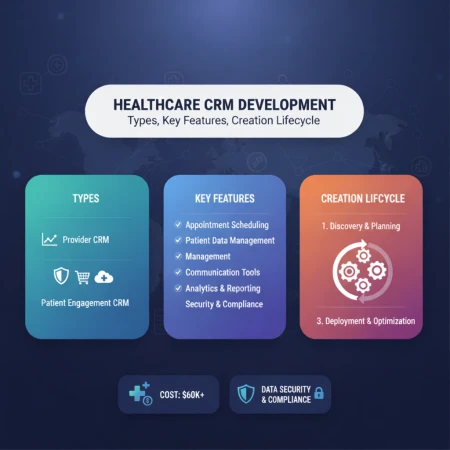
Platforms for healthcare CRM allow hospitals and clinics to handle large volumes of patient relationships, referrals, and communication more efficiently.
Tailor-made solutions are in line with regulations, promote care coordination, and assure patient engagement in the long run.
The cost of healthcare CRM development is typically $60,000 minimum and goes up depending on the variety of integrations, security, and automation.
Patient experience, data security, and regulatory compliance are the three major aspects that have the same importance as clinical outcomes in the environment where healthcare organizations function. The use of spreadsheets, email communication threads, or generic CRMs to manage patient relationships soon turns into a bottleneck. The mentioned tools do not provide medical context, nor do they come with auditability and workflow flexibility features.
For this reason, healthcare providers are increasingly investing in customized CRM systems that are explicitly designed for regulated environments. The experience of a health software development agency with delivery has revealed that such platforms work optimally when they are designed as part of a broader healthcare software ecosystem rather than as isolated tools.
A healthcare CRM is a software that supervises the whole care process, thus making it easy for medical organizations to interact with patients, providers, and partners. Its main distinguishing feature is the support of healthcare-specific workflows, protected health information, and regulatory requirements which are not offered by the common sales CRMs.
Healthcare CRMs give priority to relationship continuity over transactions. These systems facilitate organizations in different ways, for instance, by keeping track of patient communication, by making it easier to refer patients, by running care programs, and by providing support for the patient to stay engaged for long periods. An integration of these systems with EHRs, scheduling software, billing platforms, and patient portals is quite frequent.
In well-established healthcare settings, CRM systems help to steer the coordination of clinical systems and operational staff allowing non-clinical workers to come into contact with patient context without having to go through sensitive medical records.
Healthcare needs are rarely satisfied by off-the-shelf CRMs. The majority of them do not have HIPAA-compliant architecture, detailed access control, or the ability to cater to care-specific processes.
When healthcare organizations wish to, they spend on custom CRM development:
Choose the location and manner of patient data's storage
Synchronize CRM's logic with the already existing clinical and administrative workflows
Bring together different healthcare systems for a unified operational view
Back up long-term care programs and patient interaction strategies
Custom-made CRM solutions allow companies to keep pace with changes in regulations and care models, and to expand their organization without being tied to a specific vendor.
In general, all the functions of healthcare CRM systems have been mixed up into several categories of features. If we group the features right at the start, it might give us an idea about the size of the project.
Patient engagement CRMs address the entire care journey through communication and experience. They offer support for:
Appointment reminders and follow-ups
Delivery of educational content
Tracking feedback and satisfaction
Such systems have a positive impact by minimizing no-shows and increasing compliance with treatment plans.
The referral CRMs enable the management of relationships with physicians, laboratories, and affiliated organizations. The teams using them are able to:
Monitor the origins and the amount of referrals
Oversee and record the past collaborations
Take care of the communication with outside providers
The strong visibility of referrals promotes the growth of the network and the continuity of the care.
Internal staff like care coordinators and administrators are assisted by operational CRMs. They also help to manage:
Patient cases that are non-clinical
Tasks and handoffs within the organization
Departments' workflow visibility to each other
CRM of this kind minimizes manual coordination and makes operations less frictional.
To put it another way, even though other companies may not be able to see the entire picture clearly, it is a must to have healthcare CRMs (enterprise-grade ones can be inferred from the medscape-type induction) which often consist of the following building blocks.
Healthcare Customer Relationship Management systems (CRMs) keep well-organized patient profiles containing the following details:
History of interactions and communications
Data about preferences and engagement
Records of consents and permissions
The profiles give context to the non-clinical teams and at the same time, support the data minimization principles.
The communication channels that healthcare CRMs are allowed to use in compliance with regulations include:
Email and SMS messaging
In-app patient communication
Message logging and audit trails
Encryption and access control are in place to ensure that sensitive data is secured during everyday interactions.
The automation process takes away significant portion of the administrative work and brings it to the following:
Scheduling reminders
Referring patients according to their needs
Patient onboarding steps
Automation, ultimately, improves consistency and at the same time, reduces the rate of human errors.
Healthcare CRMs are monitoring the following aspects:
Patient authorization to be communicated with
Who is allowed to use the data
The complete usage as well as the frequency for audits
This feature is of utmost importance in cases of compliance review and inquiry.
Using CRM analytics, teams can keep an eye on the following areas:
Trends in patient involvement
The number of appointments that were not attended
How well referrals and communication are doing
Operational and strategic decision-making is aided by these insights.
During the process of developing custom CRM solutions, the policies related to the security and scalability lifecycle will be established, kept, and adhered to with great rigor, thereby allowing the implementation of the security norms in the medical domain.
The teams have to come up with:
The access levels and roles of the users
The integrations and data sources
The security and compliance requirements
This phase usually uncovers the hidden dependencies that exist between the workflows of the CRM and the systems in the clinic.
Design and architecture teams:
Develop interfaces according to roles
Establish encrypted data flows
Schedule integration layers
A well-done UX design diminishes the learning period and increases the acceptance.
The engineering groups are responsible for the following actions and features:
Essential functions of a CRM system
Collaboration with EHRs, coordinating appts., and financial services
Tools for communication and insight
The level of integration directly influences the reliability of the system.
Prior to going live, the following tests are carried out by teams:
Penetration testing
Access control verification
Compliance checking
All above-mentioned tests greatly diminish both the regulatory and the reputational risks.
Once the product is deployed, the teams:
Oversee the actual usage situations
Modify the processes and the automations
Adapt the system to the changing laws and standards
The healthcare CRMs are based on continuous development instead of just single delivery.
Organizations might run into problems if the development of the CRM system does not take healthcare into consideration.
These errors are very common:
CRM is not seen as a part of the whole ecosystem, treated as a separate tool
Integration complexity with EHRs and legacy systems is not considered
Compliance and audit requirements are not taken seriously
Developing one interface for all roles
It is always a better option not to commit these errors at the beginning as it is going to save time and money.
The healthcare CRM systems should be capable of supporting advancements and transitions.
The readiness of the future systems includes:
Surging numbers of patients
Emerging ways of communicating
Updating regulations
Opening of new places or new programs for providing care
The scalable architecture saves from expensive rewrites in the future.
The cost of healthcare CRM development is based on the functionality, integrations, and compliance scope.
Some typical budget estimates are:
$60,000–$90,000 for a simple CRM comprising patient profiles and communication tools
$90,000–$140,000 for a CRM that includes EHR integrations along with workflow automation
$140,000–$200,000+ for a large-scale healthcare CRM system
The use of advanced analytics, the demand for interoperability, and security audits are the factors that lead to higher investment.